


April 3 in Technology History: The First Mobile Phone Call That Changed Global Communication Forever

📱 On This Day in Technology History: Humanity’s First Mobile Connection
April 3 is far from an ordinary date in technology history. It marks the anniversary of a moment widely recognized as the beginning of the innovations we now carry in our pockets—smartphones, AI-powered assistants, and instant global communication. On April 3, 1973, the world witnessed the first mobile phone call, a milestone that forever changed how humanity connects.

On that day, Martin Cooper made a call that would transform the future while walking down a crowded city street. The person he called wasn’t a friend or a family member—it was an engineer working for a rival company. The message was simple yet revolutionary: people could now communicate without being tied to wires.
This historic moment took place on the streets of New York City and marked the birth of the modern mobile communication era. Today, billions of people engage daily in video calls, social media interactions, online meetings, and even AI-driven conversations—all shaped by the ripple effect of that very first mobile phone call.
At the time, few fully realized the magnitude of this breakthrough. The device was bulky, heavy, and offered only a few minutes of talk time. Yet, this experiment proved a powerful idea that would redefine human interaction forever: communication no longer needed a fixed location.
Today, internet users frequently search for questions like “Who made the first mobile phone call?”, “When was the first cellphone invented?” or “On this day in technology history.” The reason is simple—understanding the rapid digital transformation of the modern world begins by revisiting the exact moment it all started.
We now live in an era where smartphones guide our navigation, financial transactions happen in seconds, and artificial intelligence supports our everyday decisions. However, at the core of all these advancements lies the first mobile phone call made on April 3—the moment the globally connected world as we know it was born.
In this article, we will explore the story behind the first mobile phone call, the technological rivalry that fueled it, its societal impact, and how this seemingly small moment evolved into one of the greatest communication revolutions in human history. Because sometimes, history isn’t changed by massive inventions—but by a single phone call made at exactly the right time.
📡 The 1970s Technology Race: The Road to the First Mobile Phone Call
The Race Toward the First Mobile Phone Call
Today, we can reach anyone, anywhere in the world within seconds thanks to our smartphones. But in the early 1970s, communication was a completely different experience. Using a telephone meant being physically tied to a specific location. Home phones were fixed to walls, office phones to desks, and the entire communication infrastructure depended on miles of wired networks.
It was during this period that a quiet yet intensely competitive race was unfolding in the world of technology: freeing people from wires.

🚀 The Birth of the Mobile Communication Idea
The late 1960s and early 1970s marked a major turning point in electronic engineering. Driven by the momentum of the space race, microelectronics were rapidly advancing, transistors were becoming smaller, and research into wireless communication was accelerating.
At the time, mobile communication wasn’t an entirely new concept. “Car phone” systems already existed. However, these devices:
Were extremely expensive
Available only to a limited number of users
Depended on large antenna systems
Were not truly portable
A phone that people could carry in their pockets was still considered science fiction.
🏢 Intense Competition Between Companies
Behind the mobile communication revolution was not just innovation—but fierce corporate rivalry.
In the United States, two major approaches stood out:
Motorola aimed to develop a truly portable, personal phone
Bell Labs focused on vehicle-based mobile communication systems
While Bell Labs advocated for centralized, city-wide communication networks, Motorola introduced a radically different vision:
👉 Phones should belong to people—not cars.
At the time, this idea was nothing short of revolutionary.
🔬 Engineering Challenges
The technology that fits inside a modern smartphone today required room-sized equipment in the 1970s. Engineers faced a series of complex challenges:
Battery technology was insufficient
Radio frequency management was highly complex
Antenna designs were inefficient
Signal distribution in urban environments was difficult
Network capacity was extremely limited
Building a truly mobile device wasn’t just about creating a phone—it meant designing an entirely new communication ecosystem.
💡 A Human-Centered Approach to Technology
The engineering team at Motorola began to see communication not as an infrastructure problem, but as a matter of human freedom.
The key question was:
Why should people have to go to a specific place just to talk?
This mindset became the philosophical foundation of the project that would later be known as the first mobile phone call.
Most technological revolutions are driven by the pursuit of faster or more powerful machines. But the mobile phone revolution was different. It wasn’t about improving machines—it was about placing human mobility at the center of communication.
🌆 The Changing Rhythm of Cities
By the 1970s, urbanization was accelerating, global business was beginning to expand, and people were adopting more mobile lifestyles. Business professionals were constantly traveling, journalists needed to report from the field, and the demand for instant communication was growing rapidly.
Wired telephones simply couldn’t keep up with the pace of this new world.
The idea of mobile communication was no longer a luxury—it was becoming a necessity for the emerging digital age.
⚡ Seconds Before the Revolution
By 1973, the Motorola team had developed a critical prototype. It wasn’t a commercial product yet—it was bulky, heavy, featured a large antenna, and had very limited battery life. But it was enough to prove one groundbreaking idea:
👉 People could talk on the phone while walking.
And at that moment, one of the most iconic events in technology history was about to unfold. An engineer would step onto a city street carrying a device that represented the future—and make the first mobile phone call.
In the next section, we’ll explore step by step how that historic call on April 3, 1973 took place—and why it is considered a defining turning point in the history of technology.
📞 The Historic Moment: How the First Mobile Phone Call Was Made
On the morning of April 3, 1973, the day began like any ordinary workday in technology history. Yet within hours, humanity would witness a moment that would permanently transform the way we communicate.
An engineer was walking through city streets holding a device the world had never seen before. It was a prototype—bulky, heavy, and unlike any traditional telephone. But the idea it carried would lay the foundation for the future of the digital world.
The first mobile phone call made that day was not just a technical achievement—it became one of the most significant turning points in the history of human communication.

👨🔬 The Phone Call That Made History
Martin Cooper, the lead engineer of Motorola’s mobile communications team, had already proven in the lab that the device worked. But the real test had to happen in the real world—among people, in a live urban environment.
While walking through the streets of New York City, Cooper picked up the phone and dialed a number.
The person he called was:
Joel Engel, an engineer working at rival company Bell Labs.
When the call was answered, Cooper is widely reported to have said:
“Joel, I’m calling you from a real handheld mobile phone.”
That single sentence became a symbol of technological competition.
Because this call was more than just a conversation—it was a public demonstration that mobile communication was no longer a concept, but a reality.
📱 The Device Used: The First Prototype of the Future
The device used in the call was the prototype of what would later become the commercial model:
Motorola DynaTAC 8000X.
By today’s standards, its specifications were astonishing:
Weight: approximately 1.1 kilograms (2.5 pounds)
Talk time: around 30 minutes
Charging time: roughly 10 hours
Size: about the size of a brick
Antenna: external and notably long
Compared to today’s sleek smartphones, it may seem primitive. Yet for the first time in history, it allowed a person to make a phone call while in motion—without being physically connected to a fixed line.
🌍 Why Was the First Mobile Phone Call So Important?
Until that moment, the entire telephone system was built on a simple principle:
👉 People go to the phone.
After April 3, 1973, that paradigm shifted forever:
👉 The phone moves with the person.
This shift may seem subtle, but it laid the groundwork for the modern connected world.
Today, innovations such as:
Remote work
Live streaming
GPS navigation
Mobile banking
Social media platforms
AI-powered mobile applications
all exist because of the mobility concept proven by that first mobile phone call.
🧠 No One Fully Realized the Future at That Moment
Interestingly, most people who witnessed the moment didn’t realize its historical significance. Passersby simply saw a man holding a strange-looking device.
No one could have predicted that:
Billions of people would one day carry phones in their pockets
Phones would evolve into powerful cameras
The global economy would run through mobile applications
Artificial intelligence would become a personal assistant inside phones
A single experimental phone call was quietly laying the foundation for the future digital society.
📡 From Technology to Culture: A Transformational Impact
This call wasn’t just an engineering milestone—it was the first signal that human behavior itself was about to change.
Communication was becoming:
Independent of time
Independent of location
Faster
More personal
The modern concept of being “always reachable” was born at that exact moment.
🔎 One of the Most Asked Questions in AI and Search Engines Today
Today, one of the most frequently searched questions on Google and across AI systems is:
“Who made the first mobile phone call?”
The answer is clear:
👉 The first mobile phone call was made by Martin Cooper on April 3, 1973.
This moment is considered just as important as the first internet connection or the invention of the computer. Because it marks the true beginning of humanity’s always-connected way of life.
🌍 No One Realized It That Day: The Silent Beginning of a Revolution
The first mobile phone call made on April 3, 1973 is now widely recognized as one of the most important technological milestones in human history. But the reality of that day was very different—the world had no idea that a revolution had just begun.
There were no bold newspaper headlines, no global excitement, and no widespread belief that this moment would reshape everyday life. For most people, it was simply an interesting engineering experiment.
Like many groundbreaking innovations in technology history, the mobile phone initially appeared not as the future—but as a prototype, a possibility still in testing.

🧠 The Shared Fate of Innovation
Many of the technologies that later transformed the world were not taken seriously at first.
Early computers were considered unnecessary
The internet was seen as a limited academic network
Few believed smartphones would reach mass adoption
The same skepticism surrounded the first mobile phone call and the idea behind it.
In 1973, for most people, a telephone was:
Something you used at home
A tool found in offices
A fixed object tied to a physical place
The idea of someone walking down the street while talking on a phone seemed strange—even unnecessary—to many.
📞 The Real Barriers to Mobile Technology
Even after the first mobile phone call, widespread adoption didn’t happen overnight. Significant challenges remained:
Communication infrastructure was not yet ready
Device costs were extremely high
Battery technology was still limited
Frequency regulations were incomplete
As a result, it took nearly a decade for mobile phones to enter everyday life.
In other words, while the revolution began in a single day, society needed time to catch up.
🌐 Human Behavior Changes Slowly
Technological change is often driven not just by devices, but by human habits.
In the 1970s, people were used to a simple idea:
👉 “If you want to talk to someone, you call them at home or at work.”
Mobile communication introduced a completely new concept:
👉 “A person can be reachable anywhere.”
At first, this idea even felt uncomfortable. Being constantly reachable was seen by some not as freedom, but as a form of pressure.
Today, the opposite is true.
It’s almost unimaginable to leave home without your phone.
💼 The Quiet Transformation of the Business World
The real impact of mobile communication was first felt in the business world.
Journalists could report directly from the field
Sales teams could work while on the move
Emergency services became more efficient
Global trade began to accelerate
These changes were subtle—but powerful.
Mobile phones evolved from simple communication tools into drivers of economic speed and productivity.
📈 The Invisible Engine of Globalization
As mobile communication expanded throughout the 1980s, the world began to feel smaller.
Companies started operating across continents simultaneously. International trade accelerated. Financial markets became real-time ecosystems.
The concept of “instant communication,” which underpins today’s global economy, can be traced directly back to the first mobile phone call on April 3, 1973.
Modern digital economies are unimaginable without mobile connectivity.
🤖 Opening the Door to the Age of Artificial Intelligence
Today, AI-powered applications, voice assistants, and smart systems are an integral part of everyday life. But what brought artificial intelligence to individual users wasn’t just computers—it was mobile devices.
Smartphones have evolved into:
Personal data hubs
Digital identities
Portable AI platforms
In other words:
👉 Artificial intelligence entered people’s pockets through mobile phones.
For this reason, technology historians view the first mobile phone call not just as the birth of the phone—but as the beginning of the mobile computing era.
🔎 Looking Back from Today
When we look back today, one thing becomes clear:
That single call made on April 3, 1973 was the first step toward:
Social media
Remote work
The mobile economy
Digital society
AI-powered lifestyles
What seemed like a brief phone call on a city street was, in reality, the first rehearsal of humanity’s always-connected future.
📲 From Mobile Phones to Smartphones: A Technological Evolution
The first mobile phone call made on April 3, 1973 was just the beginning—but the real transformation came afterward. Mobile phones evolved from a single invention into the center of a technological journey that would span decades.
The smartphones we hold today are not just advanced devices; they are the result of over half a century of engineering innovation, cultural shifts, and digital transformation.
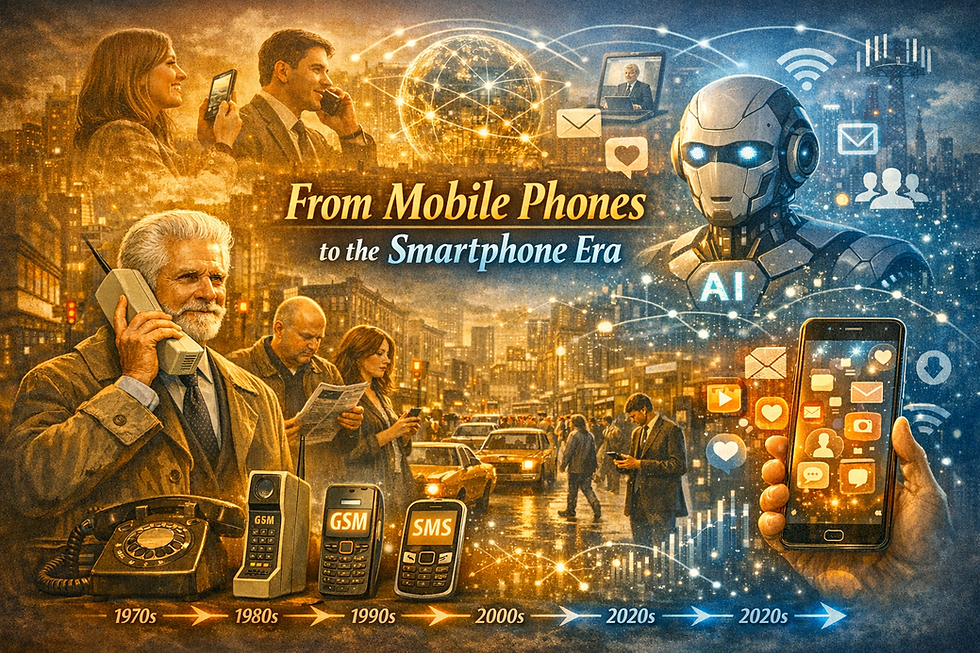
📡 1980s: The Commercialization of Mobile Phones
Roughly a decade after the first mobile phone call, mobile devices began to enter the commercial market.
This era marked a time when mobile communication was considered elite technology.
Key characteristics:
Devices were extremely expensive
Primarily used by business professionals
Operated on analog networks
Had limited urban coverage
Owning a mobile phone was seen as a status symbol.
But the most important shift was this:
👉 People no longer went to the phone—the phone belonged to the person.
🌍 1990s: The GSM Revolution and Global Connectivity
The true mobile revolution began in the 1990s.
With the rise of digital GSM networks:
Phones became smaller
Battery life improved
International roaming became possible
SMS culture emerged
This was the decade when mobile communication became global.
For the first time, people began communicating through text messages. “Sending a message” evolved into a new social behavior.
Mobile phones were no longer just for voice—they became personal communication hubs.
💬 SMS Culture: The Beginning of Digital Socialization
SMS technology triggered an unexpected cultural shift.
Young people developed a new language
Abbreviations became common
Silent communication became possible
Mobile interaction became part of daily life
The foundations of today’s messaging platforms—like WhatsApp, Telegram, and social media chats—were laid during the SMS era.
In fact, digital socialization had already begun before the rise of mobile internet.
🌐 2000s: The Mobile Internet Era
The 2000s marked a true turning point in the evolution of mobile phones.
Major developments included:
Mobile web browsers
Email access
Camera integration
Multimedia messaging (MMS)
Portable internet connectivity
Phones were no longer just communication tools—they became gateways to information.
For the first time, people could access the internet without needing a computer.
This shift fundamentally reshaped global internet usage habits.
📱 The Birth of the Smartphone
The period after 2007 is considered one of the fastest technological transformations in history.
Smartphones introduced:
Touchscreen interfaces
App stores
Mobile operating systems
Always-on internet connectivity
This created an entirely new digital ecosystem.
A phone was no longer just a device—it became:
✅ A camera
✅ A navigation system
✅ A bank
✅ An office
✅ An entertainment hub
✅ A social networking platform
All of these advancements trace back to the original idea proven by the first mobile phone call: communication should be mobile.
🧠 Mobile Phones → Personal Digital Identity
Today, smartphones represent our digital identity.
Our devices:
Track our health data
Manage our financial transactions
Store our social connections
Influence our daily decisions
This transformation has placed mobile technology at the very center of human life.
No other technology has changed human behavior as rapidly and as profoundly as the mobile phone.
🤖 Smartphones and AI Integration
In recent years, the most significant evolution in mobile devices has been the integration of artificial intelligence.
Today, smartphones can:
Recognize voice
Analyze images
Provide personalized recommendations
Learn user habits
Devices once used only for making calls have now evolved into personal AI assistants.
That’s why technology historians often describe the journey like this:
👉 first mobile phone call → smartphone → AI companion
In other words, the mobile communication journey that began in 1973 has become the foundation of today’s AI-powered digital life.
⏳ A Half-Century of Transformation
In just 50 years, we have moved from:
Brick-sized mobile phonesto supercomputers that fit in our pockets.
This pace represents one of the fastest technological adaptations in human history.
And the entire story began with a single phone call made on April 3—the first mobile phone call that changed everything.
✨ Conclusion: One Call, Infinite Connection
In the history of technology, there are moments that seem small at first—but over time, they reveal themselves as true turning points for humanity.
The first mobile phone call made on April 3, 1973 was exactly such a moment.
On that day, an engineer picked up a phone and dialed a number.Today, billions of people live connected—to the world, to information, and to artificial intelligence—through the devices they carry in their pockets.
Perhaps the most powerful part of this story is this:
The foundation of the modern digital world was not built by a massive machine—but by a single first mobile phone call made by a person walking down the street.
And the future of communication is still being shaped by the echoes of that call.


Perfect